How To Communicate When It Matters Most
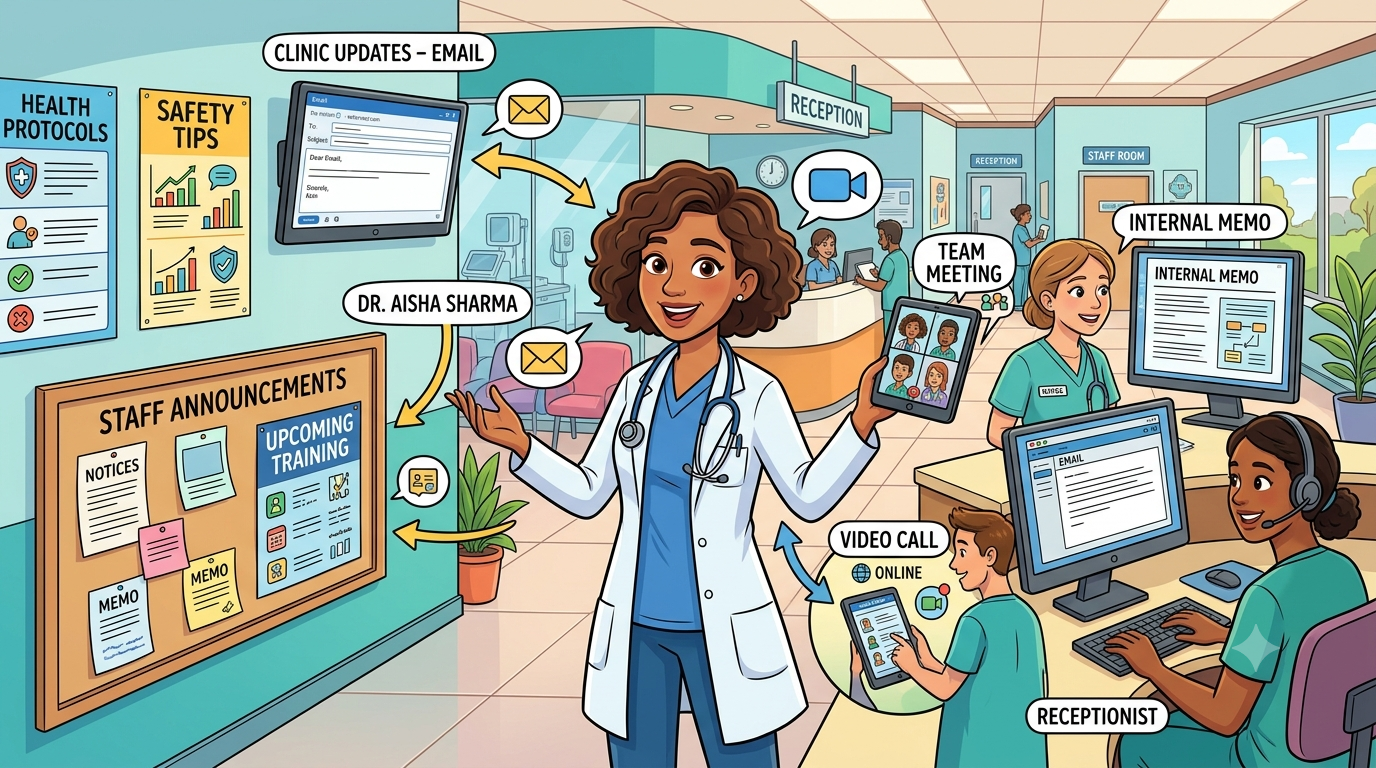
How much time do you put into communication?
Communication in a healthcare setting rarely works when saying something once and moving on.
In ophthalmology clinics especially, where teams are busy, distributed across roles, and focused on patient care, communication has to be intentional, repeated, and reinforced to actually land. If you feel like you are over-communicating, you are probably just starting to communicate enough.
Here is the reality most leaders underestimate: employees do not just need to hear a message. They need to hear it, understand it, believe it, and remember it. Each of those steps requires repetition and consistency.
Why Communication Breaks Down In Clinics
In theory, communication seems simple. You send an email, mention something in a meeting, and assume the message is delivered.
In practice, that is where things fall apart.
In a typical ophthalmology clinic:
Technicians are focused on patient flow and may not read emails until much later (or at all).
Front desk staff are juggling phones, check-ins, and insurance questions.
Providers are moving quickly between patients and may miss operational updates.
Managers assume “we already covered that last month.”
The result is predictable. Leaders believe they have communicated. Employees feel like they were left in the dark.
This gap shows up most clearly during moments of change.
When Communication Matters Most
Some topics carry more weight than others, and the higher the stakes, the more communication is required.
Benefits changes are a classic example. Even small adjustments—new carriers, plan design tweaks, or enrollment deadlines—can create confusion if not clearly explained. When communication is rushed or minimal:
Employees miss benefit enrollment deadlines.
They lose trust in leadership.
Major changes fall flat — The EMR rollout that fails. The accountability metrics that bring on eye rolls and yawns.
Now compare that to a well-communicated program in a clinic:
Multiple reminders are sent over several weeks.
Managers review the change in team huddles.
Simple guides explain key terms and FAQs.
Employees have access to someone who can answer questions.
The difference is how clearly and consistently it was communicated.
The same principles apply to all high-stakes situations like layoffs, reorganizations, or leadership changes.
Managing Employee Fear
Healthcare teams are particularly sensitive to uncertainty. When something changes—especially staffing—employees immediately start asking questions, even if they do not say them out loud:
Is the clinic financially stable?
Are more layoffs coming?
Will my workload increase?
Who is responsible for what now?
If leadership addresses these concerns once and moves on, it is not enough. Employees are unlikely to fully trust a single message, especially if there is already some skepticism or distance between leadership and staff.
In ophthalmology clinics where the physician owner is heavily focused on clinical care, communication gaps can widen quickly. When leaders are less visible, teams tend to fill in the blanks themselves—and those assumptions are often negative.
One of the most important roles of leadership is to reduce unnecessary anxiety. Not by overpromising, but by consistently reinforcing what is known, what is changing, and what employees can expect.
The “Say It Seven Times” Reality
There is no magic number, but the principle holds: you have to repeat key messages more times than feels natural.
Think of communication in layers:
First message: Some people do not hear it.
Second message: More people hear it, but some forget
Third message, most hear and remember, but many do not fully understand.
Fourth message: Understanding improves, but skepticism remains.
Fifth and beyond: Trust and retention of the message start to build.
For example, if you are implementing a new EMR system in your clinic:
Announce the change early.
Follow up with timelines and training expectations.
Reinforce the “why” behind the change.
Provide ongoing updates as milestones are reached.
Continue addressing questions even after go-live.
If you only communicate at the beginning, you leave your team to navigate the hardest part alone.
Use Multiple Communication Channels
Different people absorb information in different ways. Relying on a single method limits your effectiveness.
In a clinic setting, consider mixing:
Email for detailed information and documentation.
Short videos from leadership to convey tone and intent.
Team huddles for quick reminders and updates.
One-on-one conversations for sensitive or complex topics.
Walking the floor to answer questions in real time.
A practice administrator walking through the clinic and saying, “I know the new workflow has been frustrating this week—we are working on adjustments,” can do more to build trust than a perfectly written email.
Video is also underutilized. A short, direct message from a physician owner explaining a change can humanize the message and increase credibility.
Anticipate Questions Before They Are Asked
One of the simplest ways to improve communication is to think ahead.
Before announcing a change, ask:
What will my front desk worry about?
How will technicians experience this differently than providers?
What will people assume if I do not address it directly?
Then answer those questions proactively. For example, if you are adjusting clinic hours:
Address how schedules will change.
Clarify expectations for overtime or shift coverage.
Explain how patient demand influenced the decision.
Outline what support will be available during the transition.
When employees feel like leadership has already thought through their concerns, it reduces friction and builds confidence.
Communication Is Not Just Outbound
Strong communication is not just about sending messages. It is also about listening.
In ophthalmology clinics, this can look like:
Quick pulse surveys after a major change.
Informal check-ins with technicians and scribes.
Asking supervisors what questions they are hearing repeatedly.
Creating a small group of trusted employees to preview changes.
Leaders often skip this step because they are moving quickly. But taking time to gather input can prevent missteps and improve how changes are received.
What This Means For Your Role
If you are supporting a clinic as a practice administrator, physician owner, or HR partner, communication is not a side task. It is a core function of leadership.
A helpful way to recalibrate is to ask yourself:
Have I repeated this message enough that it is unavoidable?
Have I used more than one channel?
Have I addressed what people are worried about, not just what I want to say?
Have I created space for feedback?
If the answer to any of those is no, there is an opportunity to strengthen your approach.
Communication is not about volume for its own sake. It is about clarity, consistency, and credibility over time. When done well, it improves engagement, reduces turnover, and allows your team to focus on what matters most—delivering great patient care.
Subscribe for Ophthalmology Leadership Insights
Subscribe for biweekly (ish) emails focused on ophthalmology and healthcare! Get updates on :
HR law
Best practices for eye care practices
Updates from leaders in the eye care industry who are featured on our podcast, Eye Care Leadership Live
